How Big Is Everything? The Geometry and Volume of a Closed Universe
A story about the universe’s possible shapes — open, flat, or closed — and how its very volume might whisper secrets about the quantum nature of spacetime.
If space could bend, could it also close upon itself — turning infinity into a cosmic circle?
The Shapes of Infinity
The universe is not only expanding — it’s shaped.
Einstein’s theory of general relativity taught us that matter tells spacetime how to curve, and in return, spacetime tells matter how to move. That curvature can give the universe one of three grand destinies:
- A flat universe, endless and balanced, like a vast cosmic sheet;
- An open universe, curved outward like a saddle, destined to expand forever;
- And a closed universe, a celestial sphere where space loops back on itself — finite, yet without edges.

Each possibility emerges from the same family of equations that first made the cosmos breathe — the Friedmann equations.
(If you’d like to revisit their origin story, see How the Universe Learned to Expand?)
Measuring the Unmeasurable
If the universe were closed, one could — at least in principle — travel far enough in one direction and return to the starting point, much like circumnavigating the Earth. But in a four–dimensional spacetime, this looping geometry raises a profound question:
What is the volume of such a universe?
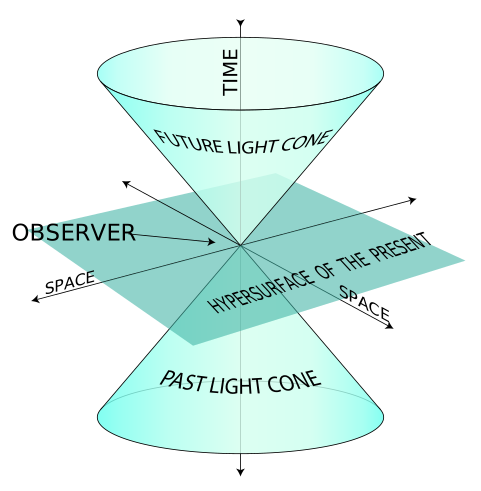
The answer lies not in ordinary three-dimensional space, but in the four–volume — the total spacetime region enclosed by the past light cone. That cone defines everything we can see or influence; it’s the boundary of cosmic memory.
By starting from the closed Friedmann–Lemaître–Robertson–Walker (FLRW) metric and integrating the spacetime volume along this cone, we can capture how the universe’s curvature and expansion jointly shape the geometry of causality itself.
The Curved Volume of Reality
In a perfectly flat spacetime, the volume inside a light cone grows smoothly with time — like a pyramid of light expanding through emptiness.
But in a closed universe, curvature bends those paths inward. The light that might have escaped in a flat cosmos now curves back, subtly altering the volume we compute.
That tiny geometric difference encodes profound physics: it is the imprint of the universe’s shape written into its spacetime structure. Through a series of curvature corrections, we can expand the closed-universe volume term by term — each correction a faint mathematical echo of how curved the cosmos truly is.
From Curved Continuum to Quantum Grain
Why care about the exact four–volume of a curved universe? Because in causal set theory, spacetime is not smooth at all — it is built from discrete “atoms” of spacetime. Each tiny element corresponds to a fundamental unit of volume, and the number of such elements in a region determines its geometry.
In this framework, the cosmological constant — the mysterious energy driving the universe’s acceleration — is predicted to fluctuate inversely with the total spacetime volume. That makes the analytic expression for the closed-universe volume more than just a geometric curiosity — it becomes the bridge between quantum discreteness and cosmic expansion.
This is the geometry that could make the universe breathe not just classically, but quantum mechanically. If you’d like to see how this idea unfolds further, continue to Causal Set Theory and the Fluctuating Λ Hypothesis.
A Note for the Curious
The full mathematical derivation — starting from the FLRW metric, integrating over the past light cone, and expanding in powers of curvature — is presented in detail in the document below. It serves as the continuum foundation for modeling quantum fluctuations in spacetime volume.
📄 Download the complete derivation (PDF)
In the end, measuring the universe’s volume is not about how much space it contains — but about how much story is written into its shape.